Some lactic acid bacteria produce polysaccharides. There are various methods for observing polysaccharides, and I find Indian ink staining to be the simplest and most straightforward. Ito recorded Lactiplantibacillus plantarum producing polysaccharides, and this video is an edited compilation that also includes footage I captured about ten years ago. The out-of-focus shots in the first half are mine.
Continue readingNew Paper on Aerobic Reuterin Production
A new paper on our lab’s lactic acid bactera Loigolactobacillus coryniformis WBB05 has just been published online. https://doi.org/10.1017/S0022029926102659 Whole-genome analysis confirmed the strain is safe for food use, showing no virulence factors, antimicrobial resistance genes, or biogenic amine-producing genes. Furthermore, comparative genomic analysis led us to propose a hypothesis that the glycerol-3-phosphate oxidase (glpO) gene plays a key role in the mechanism enabling reuterin production even under aerobic conditions.
Continue readingTop image
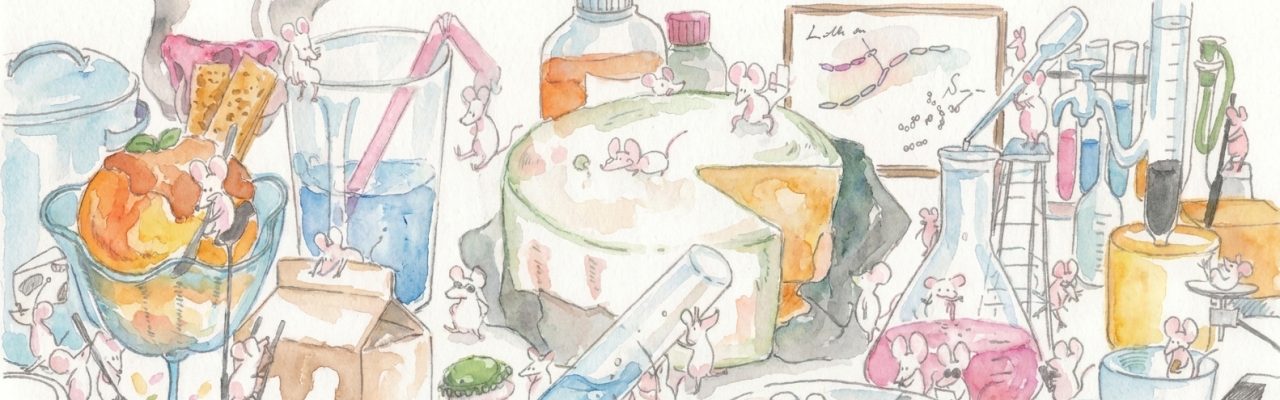
Takahashi from our lab drew the top image!! Thank you so much!! The artwork itself is wonderful, of course, and the composition and the motifs are simply amazing!
Continue readingButter making
As an undergraduate graduation research project, we are investigating the aroma of cultured butter. While typical cultured butter is often produced by adding a lactic acid bacteria culture containing diacetyl directly to the butter, our research focuses on butter made by actually fermenting the cream itself before churning. Recently, she has become quite skilled at making our own butter.
Continue readingIce cream
Our lab students produced ice cream for the second time this year. It was absolutely delicious — and most impressively, using a hand-cranked ice cream maker, they achieved an overrun of 28.8%. A great result! Next time, we’re aiming to break the 30% mark!
Continue reading