[Welcome to the EL Book Introductions series. These posts are all short (<180 words) introductions/reviews of books in the EL library. They focus on telling you what we think will be interesting for you, a college student and English learner, so use them to help you find the right book for you. You can also use the tags to find books about topics you might be interested in.]
_______
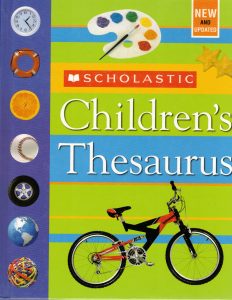
I do not like recommending “children’s books” on this blog, because most of you are in college. However, Scholastic’s Children’s Thesaurus is a really useful book for learning difficult vocabulary. A thesaurus (類語辞典) contains words like a dictionary; however, it organizes them by similar meanings. It also gives example sentences and uses pictures to help you create an image to remember.
You can use this for two different ways of studying vocabulary. First, you can learn groups of words with similar meanings. If you do this, you can remember that “new,” “fresh,” and “original” all have close definitions. Second, once you know which words have similar meanings, you can use the thesaurus to compare and understand how they have different nuances. For example, “new” emphasizes time, meaning “just made or begun.” On the other hand, “fresh” emphasizes how something is “not yet affected by time or use.” A “new vegetable” might be a variety that was recently invented, but a “fresh vegetable” is one that was just picked and has not gotten old, stale, or moldy.
My two cents: This is not a book to sit and read from cover to cover; instead, try using it to experiment with new ways of studying vocabulary.