


Oct 02
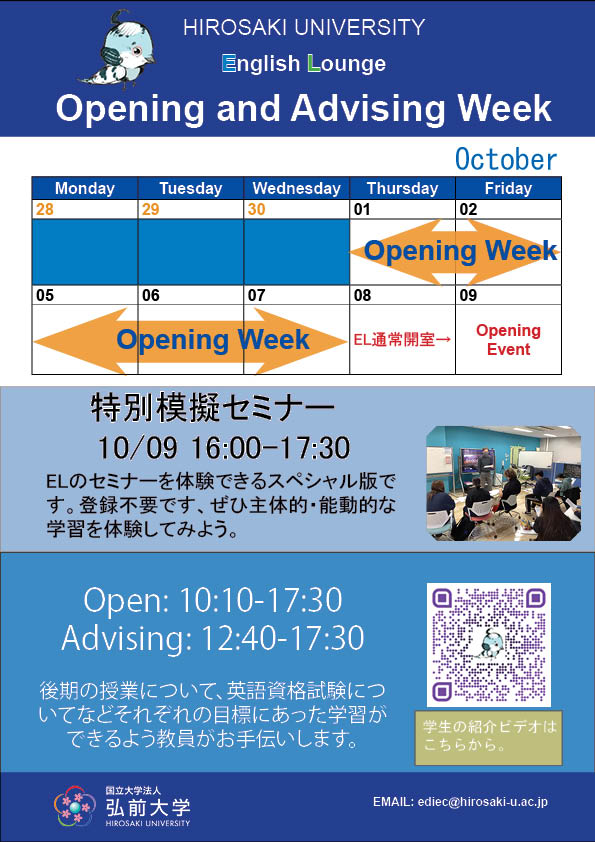
Opening and Advising Week, October 2026
We will have orientation and advising week every day from October 1, to Friday, October 9. Please stop by anytime!
We especially recommend participating in the Opening Seminar on October 9.
See you soon in the Lounge!
Sep 25
EL本棚紹介(105) Magic Treehouse #13: Vacation Under the Volcano
[Welcome to the EL Book Introductions series. These posts are all short (<180 words) introductions/reviews of books in the EL library. They focus on telling you what we think will be interesting for you, a college student and English learner, so use them to help you find the right book for you. You can also use the tags to find books about topics you might be interested in.]
_______
The English Lounge has the whole Magic Treehouse series, and you may have even read some of these books in Japanese when you were in elementary school. In each book, two children named Jack and Annie go on an adventure through space and time. Morgan le Fay (a famous witch in British literature) sends the children and their treehouse on special missions, where they learn about history, culture, and science. In Vacation Under the Volcano, they go back to ancient Rome to see the city of Pompeii before it is destroyed by a volcano. They learn about Roman culture, save an important from being destroyed, and run for their lives to escape the volcano.
Magic Treehouse is a good example of an “authentic text” (母語話者向け教材). Some students like to read textbooks that are written for language learners, but some like to read “real” books that native speakers also read. Of course, college-level authentic texts might be too difficult for Extensive Reading (多読), but children’s books might be appropriate for you. Magic Treehouse has pictures, the letters are the page are big and easy to read, and each chapter is short. This makes it very easy to read a whole book quickly. Finally, although it is a long series, you can choose any book and still understand almost everything.
My two cents: The Magic Treehouse series is written for children. Some students don’t want to read children’s books. However, if you don’t mind it, I can strongly recommend this series.

Aug 01
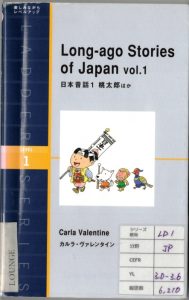
EL本棚紹介(104) Long-ago Stories of Japan, vol. 1, by Carla Valentine
[Welcome to the EL Book Introductions series. These posts are all short (<180 words) introductions/reviews of books in the EL library. They focus on telling you what we think will be interesting for you, a college student and English learner, so use them to help you find the right book for you. You can also use the tags to find books about topics you might be interested in.]
_______
“Momotaro,” “the Crane Gives Back,” “Kachi Kachi Mountain”…these are the first three stories in Long-ago Stories of Japan. Each of these folktales is very short, just 15-20 pages including pictures. Long-ago Stories of Japan is an excellent book for your Extensive Reading (多読) practice. Extensive Reading means reading a lot of easy English…but “easy” can be many different things. In this case, the sentences are not too long and the vocabulary is not too difficult. However, I think the story content is more important: Long-ago Stories of Japan is easy to read because you probably already know the stories in Japanese. Therefore, even though the Yomiyasusa Level (3.0-3.6) sounds difficult, I think this book is easier to read than that.
There are many other books in the “Ladder Series” in the English Lounge about Japan, so find something interesting to read. The letters are big and easy to read, and each story starts with a list of characters and important vocabulary words.
My two cents: While the stories are fun and easy to read, there are some very strange translations from Japanese to English. In English, it is confusing to read a monkey say “key, key” or for a bird to say “whirr.” However, if you can ignore those small things, I can easily recommend this book.
Jun 29
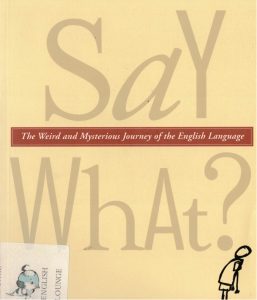
EL本棚紹介(103) Say WhAt? The Weird and Mysterious Journey of the English Language, by Gena K. Gorrell
[Welcome to the EL Book Introductions series. These posts are all short (<180 words) introductions/reviews of books in the EL library. They focus on telling you what we think will be interesting for you, a college student and English learner, so use them to help you find the right book for you. You can also use the tags to find books about topics you might be interested in.]
_______
This book has a very boring cover, but we have a saying in English: “Don’t judge a book by its cover.” Say WhAt is a very easy to approach book about the history of the English language. It contains many pictures, maps, and short quizzes. It is also written in very friendly English, so despite the boring cover, it is actually easy to recommend this book to students studying English.
Most chapters are very short—about five pages, including pictures and diagrams. Each chapter introduces a stage in the history of English or a topic related to how the language has changed. This structure also makes it easy to start with any chapter you are interested in, instead of having to start with chapter 1. There are also many examples of how English is related to other languages. This can be helpful when studying new vocabulary.
My two cents: If you are interested in language or history, I can easily recommend this book. Because of the short chapters, it is also a good choice for close reading (精読) instead off extensive reading (多読).
Jun 29
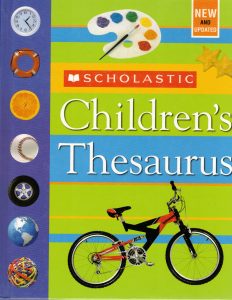
EL本棚紹介(102) Scholastic Children’s Thesaurus
[Welcome to the EL Book Introductions series. These posts are all short (<180 words) introductions/reviews of books in the EL library. They focus on telling you what we think will be interesting for you, a college student and English learner, so use them to help you find the right book for you. You can also use the tags to find books about topics you might be interested in.]
_______
I do not like recommending “children’s books” on this blog, because most of you are in college. However, Scholastic’s Children’s Thesaurus is a really useful book for learning difficult vocabulary. A thesaurus (類語辞典) contains words like a dictionary; however, it organizes them by similar meanings. It also gives example sentences and uses pictures to help you create an image to remember.
You can use this for two different ways of studying vocabulary. First, you can learn groups of words with similar meanings. If you do this, you can remember that “new,” “fresh,” and “original” all have close definitions. Second, once you know which words have similar meanings, you can use the thesaurus to compare and understand how they have different nuances. For example, “new” emphasizes time, meaning “just made or begun.” On the other hand, “fresh” emphasizes how something is “not yet affected by time or use.” A “new vegetable” might be a variety that was recently invented, but a “fresh vegetable” is one that was just picked and has not gotten old, stale, or moldy.
My two cents: This is not a book to sit and read from cover to cover; instead, try using it to experiment with new ways of studying vocabulary.
Jun 01
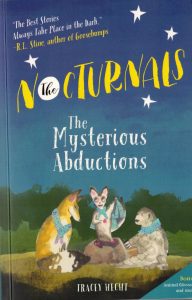
EL本棚紹介(101) The Nocturnals: The Mysterious Abductions, by Tracey Hecht
[Welcome to the EL Book Introductions series. These posts are all short (<180 words) introductions/reviews of books in the EL library. They focus on telling you what we think will be interesting for you, a college student and English learner, so use them to help you find the right book for you. You can also use the tags to find books about topics you might be interested in.]
_______
When you think of stories about animals, what do you think of? Dogs and cats? Maybe birds, or even tanuki? Well, The Nocturnals is a very different book. The main characters are all animals, but interesting animals you may not have read about before. The main characters are a red fox, a pangolin, and a sugar glider; there is also a jerboa, sea cucumbers, a wombat, and more. All of these creatures are nocturnal, animals that are awake at night.
The Nocturnals tells the story of three friends who try to solve the mystery of missing animals. The story starts as a mystery, but something strange happens in the second half: it becomes a sports story. While the language can be a little challenging, and some of the characters use foreign words (French, Spanish, and Yiddish) to express their personalities, the story itself is not too complex to follow. In addition, it is part of a series of books, so if you like the first one, you can borrow the rest from the English Lounge after!
My two cents: This book has a lot of interesting variety. It is good for people who are interested in exotic animals, sports, and mysteries.
Jun 01
EL Game Series (09): “Visual Eyes”
[Welcome to the EL game series. These posts are all short introductions to games you can play in the EL. Because learning to play games in English can take a long time, some posts will explain how to play simple versions of games. Other posts tell you why you should use games to practice English. You can also use the tags to find other posts you might be interested in.]
(ELゲーム連載へようこそ。このコラムはELで遊べるボードゲームやカードゲームを紹介します。本来のやり方通りにやってしまうと、遊ぶまでの時間が大変かかるかもしれないので、ある投稿では簡単な遊びの工夫が紹介されます。ほかの投稿ではなぜゲームで英語を勉強するのがよいかが説明されます。投稿のタグを使ってほかに興味ありそうなポストを見つけられます。)
_______
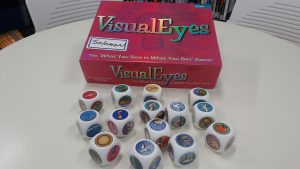
This game is all about being creative with English. The box is full of dice with strange pictures on each side. It’s your job to use the pictures to make words.
The basics: Roll all of the dice (or shake the box with them inside). Then, each player or team must write down all of the “words” or phrases that they see. For example, if you see a picture of “fire” and of a “dog,” you could write “hot dog.” Each word is worth a point.
For English Learners:
- Don’t play with the timer. This game is hard enough for native speakers.
- Think about the pictures like emoji. How do you use emoji when you text? That may help you be creative.
- Before you start playing, look at the pictures and talk about what they are. Can the picture of an “x” mean “no” or “not” or “bad”? Can the picture of the ocean mean “sea,” and therefore also mean “see”? Can the “pencil and paper” mean “write,” “draw,” or “letter”? I think so. It can be interesting even just to talk about the different pictures.
- After you roll the dice, look for a word or phrase. Instead of writing it down, put the dice together and show the group. If someone can guess the word, you both get a point.
Final Thoughts: Like “Password,” I think this is a better activity than a game. Don’t worry about points. Just try to make words and guess with your group.
Languages
-
 English
-
 日本語
日本語