[Welcome to the EL game series. These posts are all short introductions to games you can play in the EL. Because learning to play games in English can take a long time, some posts will explain how to play simple versions of games. Other posts tell you why you should use games to practice English. You can also use the tags to find other posts you might be interested in.]
(ELゲーム連載へようこそ。このコラムはELで遊べるボードゲームやカードゲームを紹介します。本来のやり方通りにやってしまうと、遊ぶまでの時間が大変かかるかもしれないので、ある投稿では簡単な遊びの工夫が紹介されます。ほかの投稿ではなぜゲームで英語を勉強するのがよいかが説明されます。投稿のタグを使ってほかに興味ありそうなポストを見つけられます。)
_______
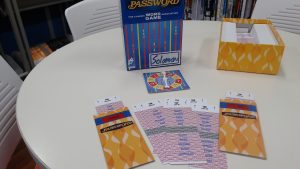
This is about as simple as a word game can get: I’m thinking of a word, and you have to guess it. That’s really almost all there is to it.
The basics: One person takes a word card and puts it in the “decoder” envelope (you will understand when you open the box). Choose one word on the card and set the score to 10. The person with the word gives a clue and their teammates guess. If they are wrong, the score goes down 1 point, and they get another clue.
For English Learners:
- The clues in the original game are just one word. For English learners, it is much better to say a sentence. For example, not “Fruit,” but “It is a kind of fruit.” This will make the game easier, too.
- Skip words that you think are too difficult for the group to guess.
- You can play with two teams guessing two different words, or play as one group. If you play as a group with scoring, only one person can guess at a time. The person who guesses correctly and the person giving the clues both get the points.
Final Thoughts: I think this is good as an activity more than a game. Using the “decoder” envelope is also kind of fun, so give it a try!